Mole Energy Powering Poultry with Solar PV

Tom Rhodes, Marketing Manager
Mole Energy
Running a modern poultry farm requires careful management of both livestock and resources. For Tom Frankpitt, who recently extended his farm near Tiverton by adding two new poultry sheds to house 16,700 Breeder layers, energy was a key consideration.
“Electricity is one of our biggest overheads,” Tom explains. “Ventilation, lighting, feeding and egg collection systems all run constantly throughout the day. We knew we needed a solution that would make the sheds more efficient and sustainable from day one.”
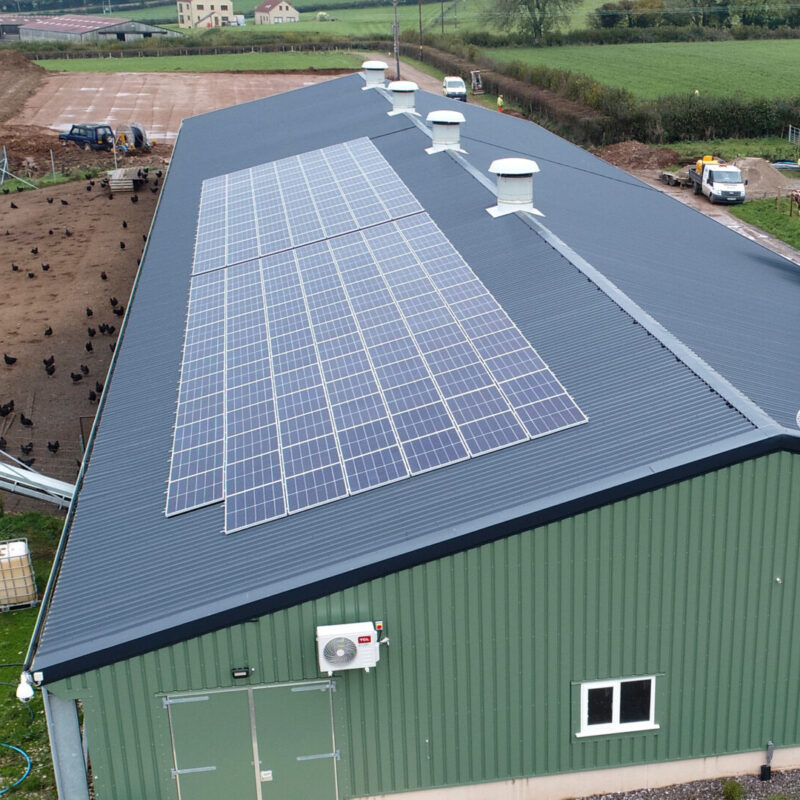
Tom had followed Mole Energy’s projects with interest, and when the opportunity arose to integrate solar PV into his new build, he seized it. Working with Mole Energy’s technical team, the plan was clear: install 132 Trina Vertex S+ 455W panels on the south-east facing tin roof, paired with a Fronius Tauro 50kW inverter.
“The shed was designed for efficiency, so it made sense to make the roof work for us too,” says Tom.
The system was modelled against the farm’s projected usage, factoring in the continuous demand from poultry housing. The numbers stacked up quickly.
“The payback period was three years and one month, with an internal rate of return of 34%. For me, it wasn’t just about sustainability, it was about making the business stronger and less reliant on imported energy. “
Since commissioning, the solar PV system has transformed how the farm consumes electricity. “We’re now covering 30% of the shed’s demand directly from the panels,” Tom notes.
Tom credits Mole Energy’s straightforward approach. “They didn’t oversell it. They showed me the data, explained the options, and let me make the decision. That gave me confidence. With so many suppliers out there, it was important to work with a company we already trusted.”
Tom’s advice to other farmers is simple. “Poultry sheds are high-energy environments, and solar PV makes real sense. It’s not just about cutting costs, it’s about making our business more resilient and sustainability.
Tom Rhodes, Marketing Manager
Mole Energy
The latest